Toward a Values-Based International Order
On October 9, 2026, Starling Institute CEO and co-founder Minh-Thu Pham delivered a keynote speech at the Joint Biennial Meeting of the World Council of Churches (WCC) Commissions and Reference Groups of Peace, Justice, and Life. Minh-Thu spoke at a plenary session titled “Toward a Values-Based International Order – The Distinctive Contribution of Churches.” This transcript of the keynote speech was lightly edited for readability. The speech was interactive, and the transcript seeks to represent that where possible.
Thanks so much, colleagues. It’s such a pleasure to be here, and thank you to Peter [Prove] for inviting me here. I am, as you’ve heard, an outsider to your group. And, I am just thrilled to be here. I'm an outsider in a couple of different ways. Maybe one is that I’m not a member of the World Council of Churches. And, I’m also a Buddhist. The way I approach these issues is very informed by my own spirituality and faith.
I’ve spent the better part of two decades around the international system, in the international order, and observing what works and what doesn’t. And, I thought that today I would share with you a bit about the observations that I’ve seen, and then what I think we might be able to do about it.
I essentially want to make the case to you that we are at a moment when we need a global movement for morality and the rule of law. And, I think it has to be grounded in faith, values, and what networks like this can do together.
So, as professors of international relations often do when discussing international policy, I like to try to illustrate the problems we’re seeing in a values-based international order by using an analogy. And, if you talk to international lawyers, they often will use a traffic analogy. I think that might be pertinent here.

This is an image of an intersection. I came to the United States as a refugee, but I’m an adopted American – this is an image from Iowa. And, you’ll see that it’s flat, in the middle of the day. There are no obstructions blocking your view of what’s happening.
Imagine you are driving a car and you’re coming up to this intersection. You see that there’s not one but two stop signs here. Someone really wanted you to stop. But, you look around and you see that there’s nothing here, right? There are no vehicles you might hit if you were to drive through it. There are no obstructions. It looks like you could probably go through this.
In the United States, it is the law that if you see a stop sign you have to stop. The rule, or norm, is that if you see a stop sign, and here again, it’s not just one but two, you’re supposed to come to a full stop.
So, let me see a show of hands. Raise your hands if you would actually come to a full stop. Now, raise your hand if you might roll through the intersection, maybe slow down a little bit, look around, and then maybe just proceed. How many of you would say: “there’s nothing here, I’m fine, I’m just going to go.”
Now, let’s say that you urgently need to get to where you are going, and you had a very good excuse. What if you have a sick child in the back? What if you really need to get to the hospital? What would you do? Who would just go through it?
For those of you who would come to a full stop, tell me why. Audience answers included: "because I’ve been prosecuted for not doing so,” “in the U.S., breaking the law could end up losing your license,” “it’s the law,” “you just stop without thinking, it’s automatic,” and “because as a healthcare professional, rural, high speed car accidents are lethal.”
Okay, so it’s the law. There are consequences. You’re afraid that maybe there’s a camera, or a police officer, somewhere you didn’t see and you’ll be penalized for it. Or, because you have internalized it. You automatically see it and you just follow the rules.
There are values underwriting your reaction as you came to this intersection. We are often confronted with a decision as to whether to abide by the norm or principle, or the rules, and then we have to decide what to do about it.
Sometimes it’s automatic. Sometimes, a person will just do whatever it is that they wanted to do. And, they’ll even come up with a really good justification for their actions. Some will look around and think it’s okay, they’ll get away with it, and just proceed. Some will come to a full stop and abide by the letter of the law, or the letter of the values they were taught, because it’s just automatic, because you have so deeply internalized it.
Some will do it because of cultural reasons. In that setting you’re in, perhaps there’s a permissive environment to do it because everyone else does it. So, even if everyone knows that’s the rule or the norm, most people just violate it anyway because it’s really no big deal. “What’s the harm? You gotta go through. Everyone does it. No big deal.”
I think different factors shape that decision, whether it's conscious or subconscious. Through this lens we can understand what the values-based international order is all about.
In a domestic setting, such as in the United States, you’ll have a police officer. There is law enforcement. On the international stage, we do not have law enforcement. We don’t have anyone who’s going to enforce and impose the consequences. Remember, the penalties are why so many of you decided to stop.
So, consent on the international stage is really important. Consent, meaning that you fully agree with that norm or rule.
On the international stage, are there consequences if a state decides to violate a norm? If a state decides to go and invade another state, even though war is illegal, can you justify it? Can you come up with a really good excuse? A state might say that, “yes, this might have been a violation of an international norm or a value, but I had a really good excuse. This was self-defense. This is an exception. My people have been abused, my people have been persecuted, and therefore this is okay.”
There’s also an understanding of what’s acceptable. Maybe there are cultural or societal expectations that come along with whether a state or a leader, or someone, decides to behave in a certain way.
And, yet, none of these things are necessarily right or wrong. Those of you who raised your hand and said, “yes, I might just slow down and drive through it:” that doesn’t necessarily mean you are wrong, because there’s also an environment that helped to determine what you decided.
A values-based international order is one in which we have to then figure out – do we understand and consent to those values? Who wrote those rules? Whose values are they? Are there ways, then, that we can uphold those values if we do believe in them, meaning we abide by them and expect others to? Then, will we enforce it so that others do? And, lastly, do these values apply to everyone? Is anyone above the law? Is anyone above those rules? What you’ve seen is that those questions have been undermined over the last few decades or so.
But, there’s another way to look at this. Let’s say that you are in that driver's seat and you are driving through the intersection. For those of you who slowed down, you decided to look around and crawl through, but you questioned it, right? You didn’t just decide because it’s automatic. And, you didn’t just decide to go through because you said, “oh, there’s no consequences. I’m just gonna do it.” But, maybe you had a thought: does this rule now apply? Is the law still legitimate in this case?
There is a discernment; you enter with a query, checking, testing, to make sure that the value is still relevant. Whose values are there? And, I think over the last few days, what I’ve been hearing from you all is that you’ve deeply grappled with that question. Whose values still hold? Do we need to revisit them? How do we now think about it in this context?
In Stockholm in 1925, this conference convened amid geopolitical and spiritual divisions in the aftermath of World War I. I think we're actually at that exact moment right now. There is a deep crisis. Your predecessors in 1925 came together to unite to address the moral crisis that confronted them. They tried to address peace, justice, dialogue, to get better cooperation. And, that formed the basis, the moral basis and framework, for international law.
Since then, we’ve seen a lot of hypocrisy. The countries and leaders that wrote those rules, decided on those values, have not been abiding by the promises that they made. Maybe they violated the rules that they expected others to follow. That’s created a crisis.
When it happens frequently, it also creates a permissive environment where others then fail to follow as well – “if that leader, that country, can get away with it, why can’t I? If they’re above the law, why should I follow it?”
That has led to erosion of a shared consensus about what’s right and what’s wrong. You can ask, are universal values relevant anymore? Are there universal morals and norms anymore? Or, maybe that was a Western tradition but now other cultures are becoming more dominant. There has been an erosion, or a kind of walking away, from Western values. I would argue that there are certain values and norms that are universal, no matter what philosophical tradition – I’m Buddhist – no matter what culture or language or religious philosophy you come from, there are some basic norms and values, and I think we all know what those are.
There is moral equivalency, sure, but there are also some universal values and norms. And, part of the crisis is that those who want to erode it are then questioning and saying: “you weren’t there when the UN Charter was founded, so these are not your values anymore.” This is actually not true. There are developing countries all over the world who were not there when the Charter was signed, and they are now the ones upholding those principles more than the governments that were at the table, that did write those rules.
So, the nature of the crisis right now is a crisis of legitimacy, of declining respect for international law, and maybe a lack of representation in the multilateral institutions. There is an institutional crisis of efficiency, of funding, of delivery, and of fragmentation. But, I think the most important reason for the crisis is a crisis of consent. Do we still all agree on the rules and whether they should be followed by everyone?
I want to talk about what we can do about it.
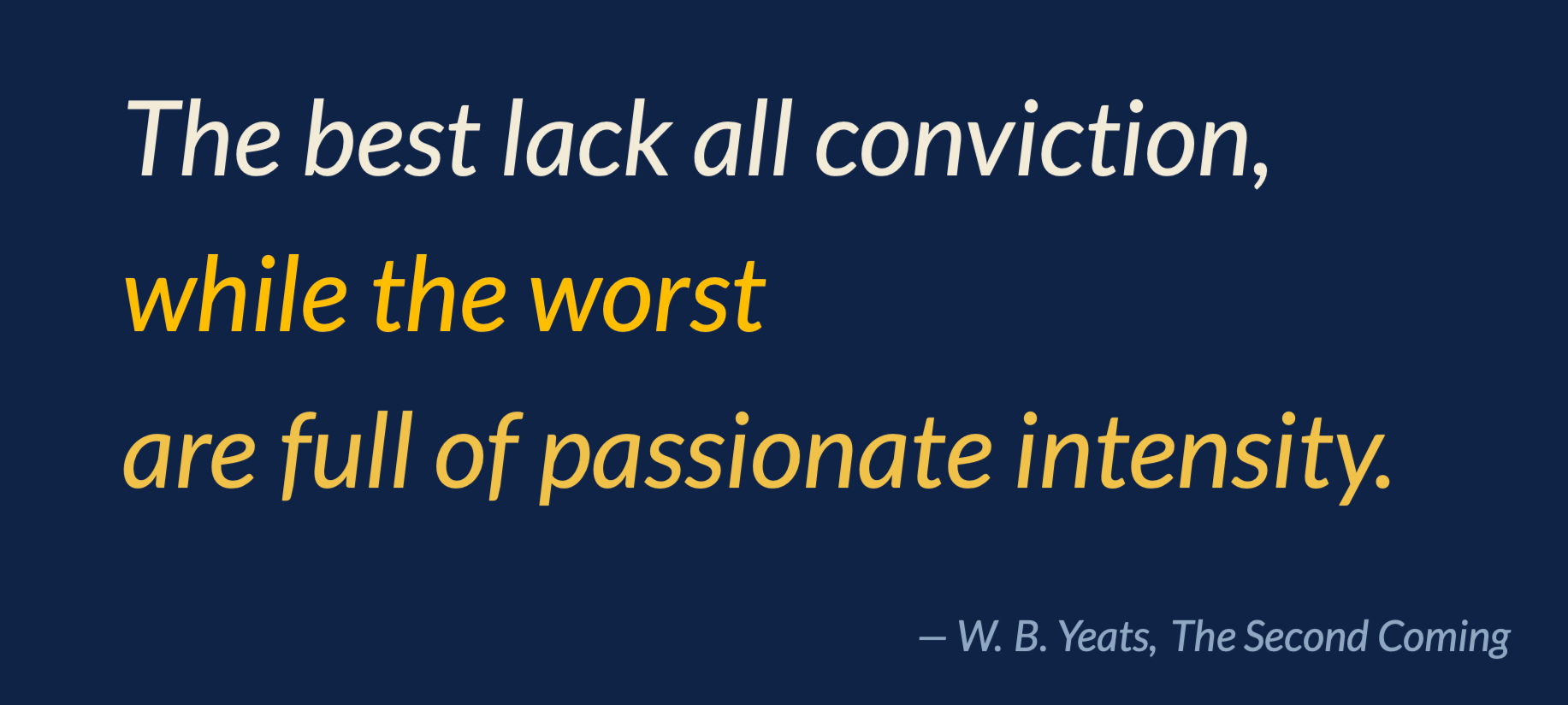
This is a line from a Yeats poem: “the best lack all conviction, while the worst are full of passionate intensity.” What does this mean? Those of us who care about the values, universal values and norms, maybe have also lost faith in our conviction that there is a clear right and wrong in the world, that there are universal values.
And, those who are full of passionate intensity don’t care about those rules. They’re gonna violate them because they can. Because might makes right. And, they are much more committed to their point of view. Whether it's governments around the world, or oligarchs, or the heads of giant technology companies, there are people out there that are much more committed to their side than those of us who are trying to uphold the rules.
“The best lack all conviction, while the worst are full of passionate intensity.” This cannot be what guides us right now, but it is. So, what do we do about it?
We need to organize and build a movement for these values. Don’t let the perfect be the enemy of the good. Maybe we disagree on some things, gender or health or climate or whatever the case may be, and then we equivocate and don’t support general convergence around those values and norms that are universal.
If we're not quite sure whether those rules still apply, we're not quite sure that our perspective can be imposed, universal values imposed on others, so then we're not as passionate or dedicated to it. The other side's gonna take the opportunity. They have a vision that they are determined to push forward. And if we aren't sure about our vision, we're gonna lose.
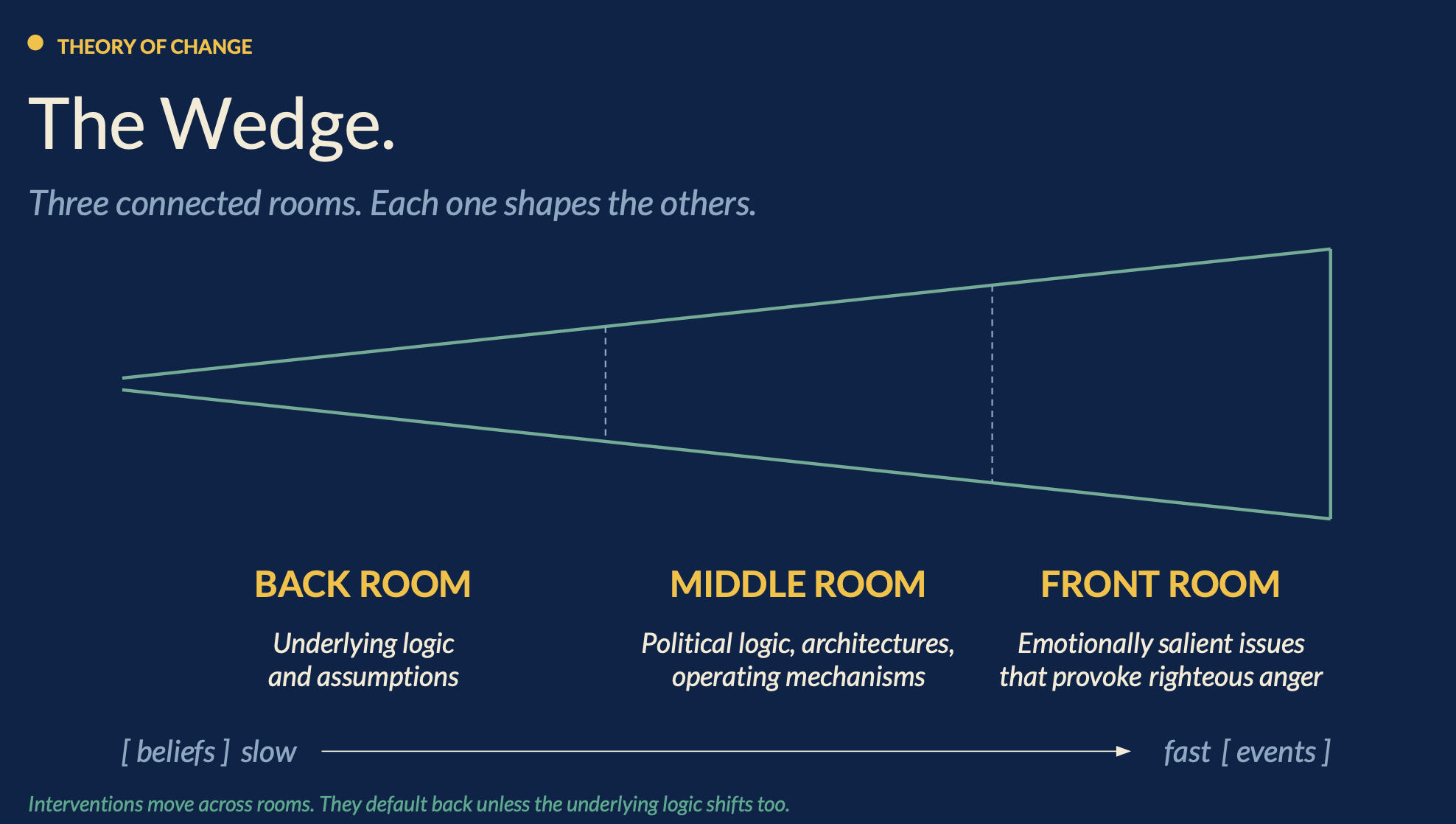
Here’s my proposed theory of change. This is how change happens. And, it's about the practice of deep collaboration in building networks around a common cause, and how we mobilize them.
So, if you imagine that it is a bullhorn, the front part is where the sound comes out. This is the front room. That is where you can imagine a room where the emotionally salient issues provoke righteous anger – where people see that justice is not served, that the poor are being undermined or taken advantage of, or that the rules are not applying to everyone. It makes people upset and angry. Here there are the campaigners, and the activists, and the faith leaders, right on the front lines of this, where you’re hearing people's angst and frustration and anger.
In the middle room you have the institutionalists, the people like myself who know how these institutions work who maybe understand the political logic and architecture of the institutions and the operating mechanisms for how you move certain types of behavior. We know how to tweak the institutions – “let’s reform the UN Security Council; let’s rewrite the UN Charter.”
These are technical institutional fixes. But, they do not respond to the people in the front room who are saying: “look at what is happening around the world. Look at Sudan, or Gaza, or Ukraine.” And, then they say: “and you want to add more members to the UN Security Council? How is that the answer to our challenges right now?”
And, then you have the back room. These are the philosophers, the faith leaders, the academics, the theorists, the deep thinkers who have been thinking about the underlying assumptions, the underlying logic of how humans behave, how power works, what motivates us. How do we show love in the world? How do we care for one another? And what are our deepest motivations? Those folks are not necessarily talking to the people in the other rooms.
And, if you imagine the kinds of people that populate each of these rooms, and you were to put them all in the same room and said “let’s figure out the solution together”, I think you’d have a much deeper theory of change to actually shift the trajectory of where we are than if you just let the loudest voices lead – the people who are just the people who are just trying to understand and address the acute anger, or the institutionalists, who are often very incremental, and are just looking at how do you change words on a piece of paper.
And, then you have the deep thinkers, but nobody listens to them because they do amazing sermons while the rest of the world is moving on. Or, academics who write long theoretical papers in academic journals that nobody reads.
But, if you actually brought them all together, I think you would actually have a much more powerful solution that gets at the underlying causes.
We need to examine – what are our strengths and our power? And, if we brought these folks together, I think we’d find that we could have the moral authority where we’re speaking from the values in a way based in universal shared norms, that is harnessing the power of the numbers we have. I think it's amazing that this network has over 500 million members that you could mobilize – if you just mobilize one percent of those, imagine what we could do.
There’s also power in numbers, if you look across the world. Global South governments are not sitting back. They’re looking at this momentum of transition and saying: “if the United States and the great powers are backing away, or are just fighting amongst themselves, what do the rest of us do?” “There are five permanent members of the UN Security Council. There are 188 of the rest of us.” What would happen if we actually got our governments to come together, to defend some universal values and norms? Let's assess what leverage we have, what voice, what power? What levers of influence do we have? And then, let’s organize and move it forward.
So, the moral crisis right now is just as deep, or maybe even more, than in 1925. What will we do at the moment? How could you find the conviction and create the momentum for intentional dialogue and deep collaboration, so that we can create a moral movement for peace and justice?
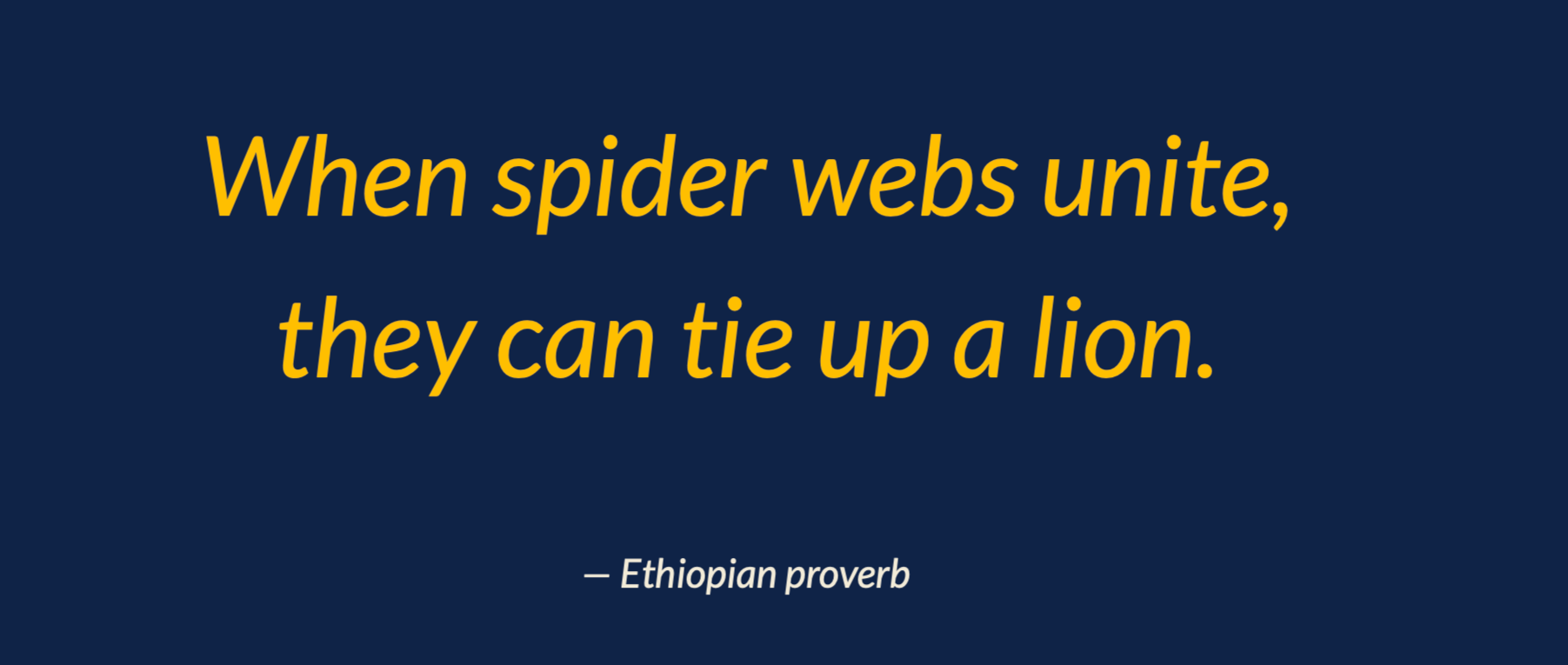
I lived in Ethiopia for a bit of time early in my career. This is an Ethiopian proverb: “when spiderwebs unite, they can tie up a lion.” I really, truly, believe this.